What Are Snap Fasteners? Parts, Specifications & Installation
Snap fasteners are common hardware fasteners in clothing, bags, leather goods, outdoor products, pet supplies, and various fabric products. For general users, snap fasteners are just accessories used for opening and closing; however, for companies with OEM or customization needs, the structure, size, material, and riveting method of snap fasteners will directly affect product quality, assembly efficiency, and subsequent customer complaint rate.
What is a snap fastener? Its construction and operating principle.
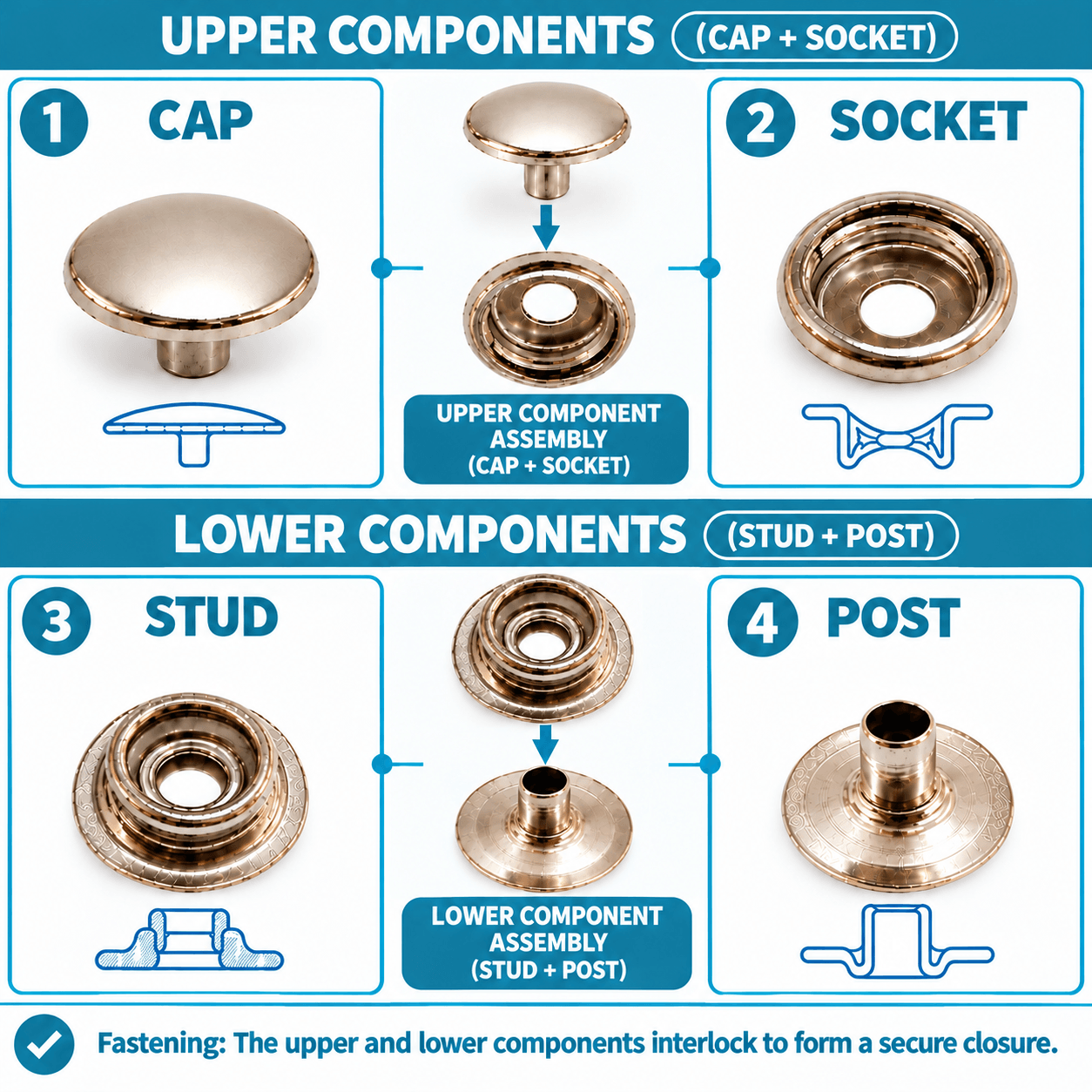
Snap fasteners are press-fit metal fasteners consisting of four parts. A complete set of snap fasteners typically consists of four parts: a front snap, a female snap, a male snap, and a bottom snap. After installation, the four parts separate into upper and lower halves, forming a stable and repeatedly opening and closing structure through the engagement of the female and male snaps. This structure is suitable for products that require repeated opening and closing but where a neat appearance and tactile feel are desired, such as outerwear, baby products, bags, and workwear.
For contract manufacturers, the value of snap fasteners lies not only in their ability to fasten securely, but also in their ability to maintain stable tensile strength and consistent appearance even after repeated use. Therefore, materials, dimensions, tolerances, and installation methods all directly affect the quality of the finished product.
1. Facing buckle: The outermost decorative surface of the product.
The snap fastener is the most visible part of a snap fastener, primarily located on the front of the product, serving both decorative and brand identification functions. Snap fasteners can be made in various diameters, shapes, colors, and surface finishes, and can also be customized with logos, patterns, or special shapes according to brand requirements. For apparel brands, bag manufacturers, and leather goods OEMs, snap fasteners not only need to be aesthetically pleasing but also must complement the fabric, leather, and overall product style. Common surface treatments include glossy, matte, bronze, black nickel, electroplating, and special paint finishes.
2. Female snap fastener: A fastening part containing a spring or groove.
The female snap fastener is located in the upper part and usually has a spring structure or groove inside to engage with the male snap fastener below. The structural precision of the female snap fastener affects the feel, stability, and lifespan of the fastener. If the dimensions of the female and male snap fasteners are not aligned, it may result in a loose fastener, easy detachment, or excessive difficulty in opening and closing. Therefore, when selecting a snap fastener supplier, companies should confirm whether the products have stable dimensional tolerances and batch quality control.
3. Male snap fastener: The protruding structure responsible for inserting into the female snap fastener.
The male buckle is located in the lower half and is usually a protruding columnar structure. Its main function is to insert into the female buckle to complete the fastening. The height, diameter, and surface finish of the male buckle will affect the actual fastening force. If the male buckle specifications do not match the female buckle, the product may loosen during use, or the fabric, leather, and buckle may be damaged due to excessive tightness. Therefore, both the male and female buckles must be confirmed during the development phase, and it is not recommended to replace only one part.
4. Bottom buckle: A supporting part fixed to the back of the material.
The bottom buckle is located on the back of the fabric, leather, or other materials, primarily used to secure the male buckle and support the entire lower structure. The length of the bottom buckle post and the size of the base need to be selected based on the material thickness. If the bottom buckle is too short, it may not be able to be riveted smoothly; if it is too long, it may cause deformation, loosening, or affect the appearance. For the OEM manufacturer, the fabric thickness, the number of leather layers, and the riveting method should all be confirmed during sampling.
Enterprise procurement pain points: How does the structure of hardware affect product yield?
Once the structure is understood, development engineers can accurately identify potential risks during contract manufacturing. In mass production, the most common customer complaints often stem from the following two structural flaws:
- The tube length and fabric thickness do not match (bottom buckle issue).
If the tube of the bottom buckle is too short, the amount of metal crimp after pressing will not be enough to hold the male buckle, and the product will fall off completely after a few pulls; if the tube is too long, the metal tube will be squeezed and deformed during pressing, or even puncture the front buckle. Professional hardware manufacturers must have the ability to assist customers in assessing the matching degree between fabric thickness and tube length. - Uneven opening and closing force (male and female fastener tolerance issue)
If the stamping tolerances of the male and female snaps are too large, the snaps will be too tight to open and tear the fabric, or too loose and open with a single pull. This is extremely dependent on the mold precision and ISO quality management standards of the OEM manufacturer.
What specifications need to be confirmed during OEM custom development?
If your company has OEM or customization needs for snap fasteners, we recommend providing the following information to the hardware manufacturer:
- Materials used and total thickness
- Outer and internal dimensions of snap fasteners
- The required fastening force for the product
- Usage environment, such as outdoors, humid, or high-frequency opening and closing.
- Material requirements, such as copper, iron, stainless steel, or PVC.
- Surface treatment and color
- Do you need a logo, pattern, or special design?
- Expected sample quantity and mass production quantity
Hsin Yi Metal offers snap fasteners, spring snaps, five-prong snaps, PVC snaps, and decorative snaps. We can assist in evaluating materials, dimensions, fastening structures, and surface treatments based on customer drawings, samples, and product applications. From mold development and sample confirmation to mass production supply, we help OEMs, ODMs, brand owners, and contract manufacturers reduce development risks and establish more stable hardware accessory solutions.
Frequently Asked Questions
Q1: If we develop a snap fastener with a custom logo, will we need to modify four parts?
No. Usually, only the face buckle needs to be custom-molded separately. The female buckle, male buckle, and bottom buckle can use SINYI's high-quality generic standard parts, which can significantly reduce the company's development costs and cycle time.
Q2: What if our product (such as heavy leather) is very thick and the standard bottom buckle cannot be installed?
SINYI Metal offers a variety of extended diameter bottom buckle specifications and can conduct on-site measurements based on the leather thickness sample provided by your company to provide the most suitable hardware matching solution.
Q3: Do you have to use a special tool for snap fasteners?
It depends on the model. Some are tool-free, but most metal and plastic snap fasteners still require corresponding molds or presses.
Q4: Can molds of different sizes be used together?
No. Different sizes usually require corresponding tools and cannot be mixed.
If you are looking for Taiwan snap fastener manufacturer We welcome custom snap fastener suppliers or apparel hardware OEM manufacturers to provide product drawings or samples. Contact SINYI, let our professional team help you determine the most suitable snap fastener structure.
CONTACTUS
We strive to bring you quality products with a minimal approach of design.
DISCOVER MORE